In today’s digital marketplace, choosing the right website builder isn’t as simple as picking the first platform you come across. With tools like WordPress, Wix, Squarespace, and Shopify all promising simplicity and performance, many business owners feel overwhelmed before they even start. That’s why we sat down with a Pixwelz web strategist, someone who builds on multiple platforms and understands how different businesses benefit from different solutions.
According to industry experts, the best website builder depends on your needs, whether you value ease-of-use, long-term scalability, visual design priorities, or e-commerce functionality. Platforms like WordPress offer unmatched flexibility and control over SEO, while Wix and Squarespace simplify the process for beginners, and dedicated e-commerce platforms excel for online selling.
At Pixwelz LTD, we’ve worked across WordPress, Shopify, and fully custom builds, giving us a front-row seat to what works and what doesn’t. In this interview, we’ll uncover practical insights for choosing your ideal website builder in 2026, explore common mistakes business owners make, and share expert guidance to help you build smarter, not just faster.
The Common Mistakes Business Owners Make
Q: “What are the most common mistakes business owners make when choosing a website builder?”
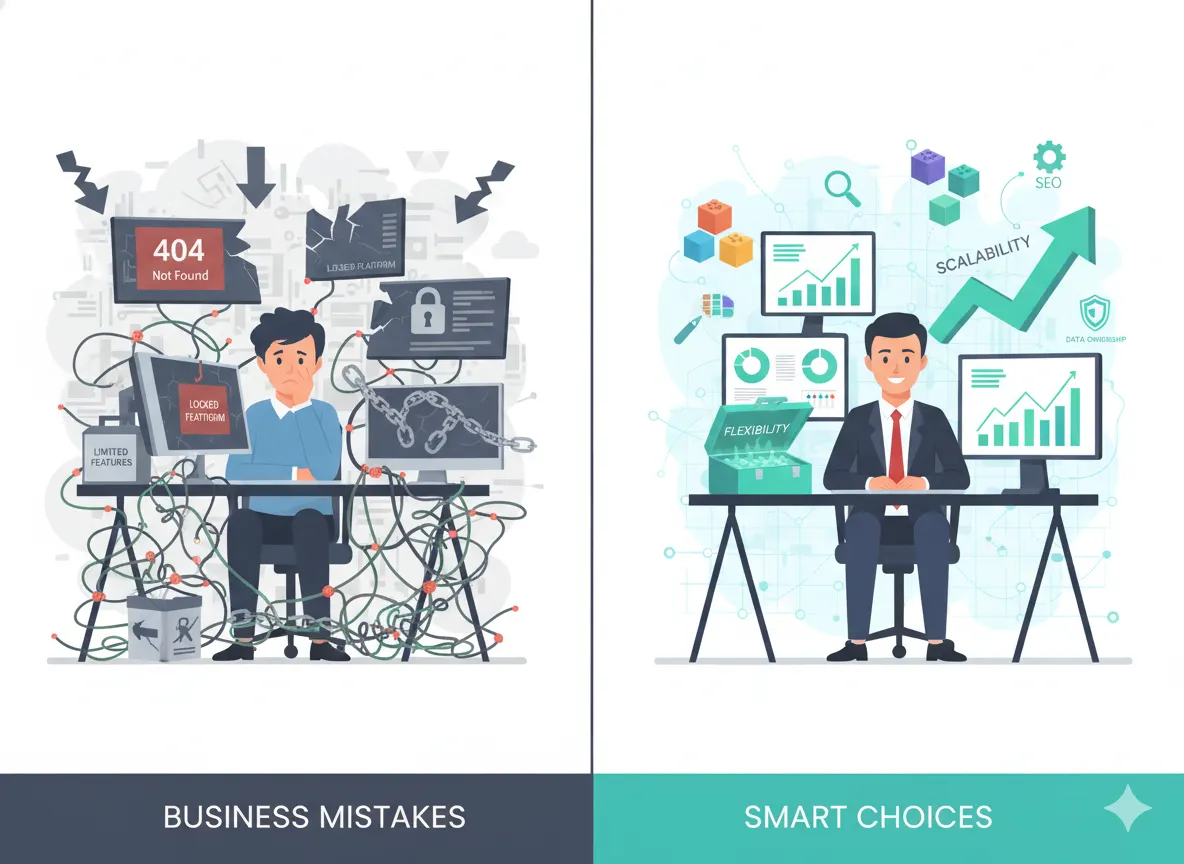
Honestly, the biggest mistake we see is choosing a platform because an advertisement said it was easy or cheap. Business owners often choose whatever promises the fastest launch, without verifying whether it actually aligns with their goals. Experts widely note that the best platform is the one aligned with your business needs, not just the most affordable or most promoted.
Another major mistake is ignoring scalability. Many website builders are great for getting started, but become restrictive when a business grows, especially platforms with limited customization or advanced functionality. Switching platforms later can mean rebuilding the site from scratch, which can be costly in time and resources.
A third common issue is judging a builder only by its templates or visuals. Good design matters, but it must support user experience, brand goals, and search visibility. WordPress, for example, is often preferred because it offers more SEO control and flexibility as a site expands.
Finally, business owners often overlook ownership. Hosted builders may limit access to your data, code, or ability to migrate, while open platforms like WordPress provide greater control.
A cheap builder can get you online, but the wrong one can keep you from growing.
Choosing Between Wix, WordPress, and Shopify
Q: “How do you decide whether a business should use Wix, WordPress, or Shopify?”
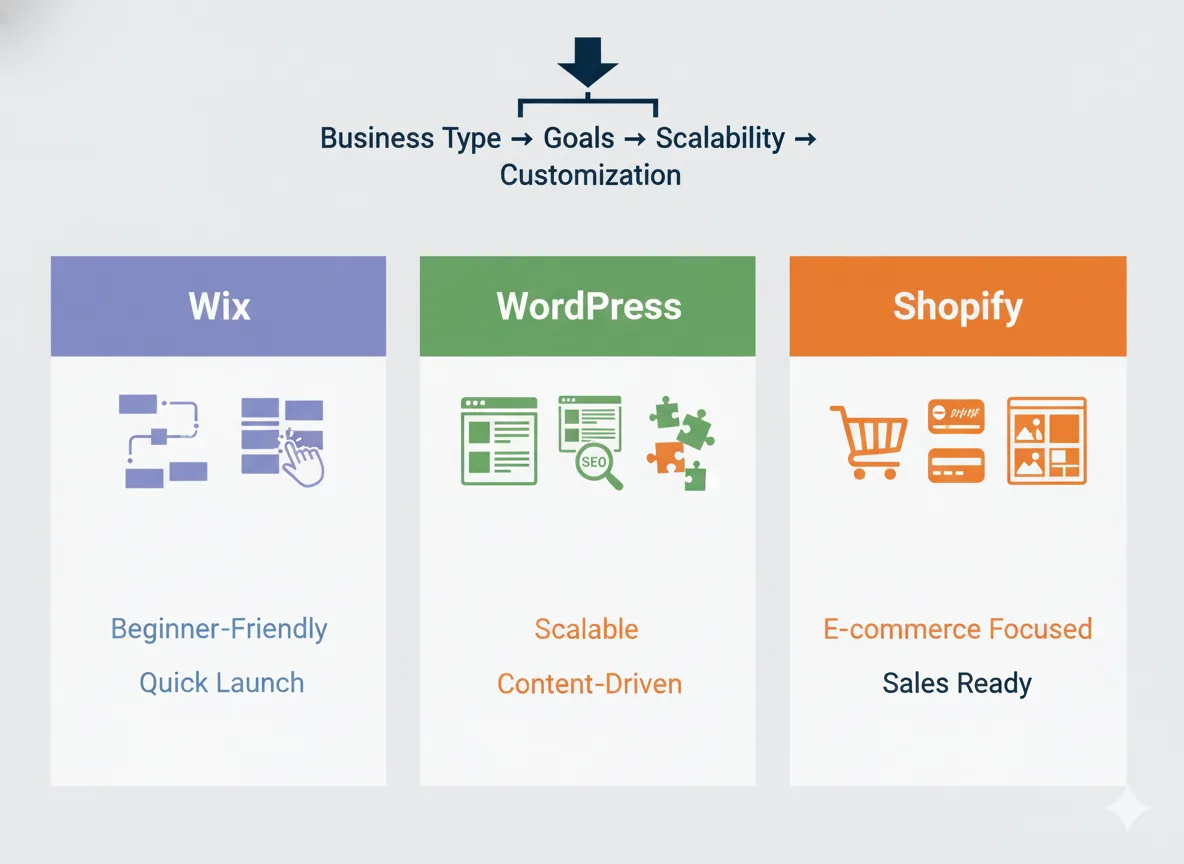
First, we look at the business model because different platforms suit different needs.
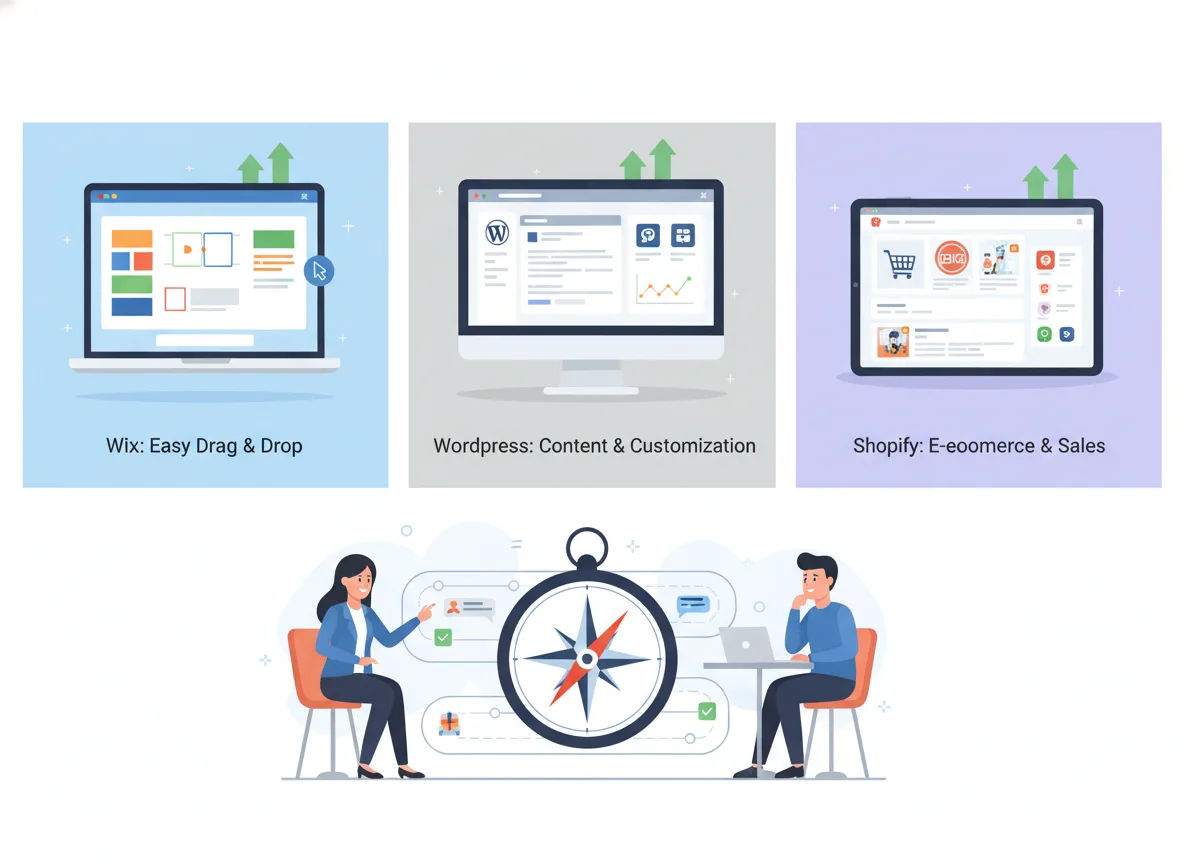
Wix is usually ideal for beginners or very small businesses that want simplicity and speed. Its drag-and-drop editor is user-friendly, making it great for portfolios, basic service sites, or startups that need to launch quickly without technical setup. The trade-off is flexibility: Wix works well early on, but advanced customization and scalability are more limited.
WordPress.org is our go-to recommendation for businesses that expect to scale, publish ongoing content, or value SEO. It’s widely recognized for its flexibility, plugin ecosystem, and deeper SEO control compared to hosted builders. It does require more setup and maintenance, but it gives you ownership and room to grow, making it strong for content-driven and evolving brands.
Finally, shopify is the ideal choice for online stores that prioritize selling, especially if they expect expansion. It’s considered by many to be the best dedicated e-commerce platform because it handles storefront tools, payments, shipping, and scalability reliably.
So our decision framework is always:
Business type → Goals → Scalability → Customization needs.
A portfolio consultant may thrive on Wix. A brand with content plans and future features is better suited to WordPress. An online retailer should consider Shopify.
And here’s a pro-tip we share with clients:
“We often help clients start with a builder and later transition to a professional WordPress or Shopify setup when they outgrow it.”
Because it’s common for businesses expand their services, traffic, and customer expectations, they start needing features their original builder wasn’t designed to support.
Branding & UX Matter More Than Builders
Q: “How does branding and user experience (UX) influence the choice of a website builder?”
When selecting a website platform, too many business owners focus only on templates or flashy design themes, but that’s only the surface. What really matters is brand identity and user experience (UX). A website builder should be judged by how well it lets you express your brand personality and deliver a smooth, trustworthy experience for your users.
Why Brand & UX Are Crucial, Not Just the Builder
Branding is more than a logo or colours, it’s the soul of your business, expressed consistently across every digital touchpoint. When branding is embedded into UX, your visitors don’t just see a site: they feel the values, tone, and promise of your business from the moment they arrive. Good UX + strong branding builds recognition, trust, and loyalty.

On the flip side, many builders rely on pre-made templates that, while convenient, tend to produce generic-looking sites. That means even if you put your logo and colours, the underlying layout, components, or navigation may not fully reflect your brand and that risks making your site look like just another template.

From a UX perspective, a website’s usability, navigation, responsiveness, and overall user flow are critical. A site with a good UX guides a user smoothly, helping them find what they need, understand your message, and trust your brand. That trust often translates into engagement, conversions, or returning customers.

Why Some Builders and Templates Fall Short and How We at Pixwelz Address This
Template-based builders or off-the-shelf themes can work for simple sites. But they also often come with built-in constraints: limited layout options, fixed navigation patterns, standard components and UIs that hundreds of other sites might use. That makes true brand differentiation difficult.

Also, templates may not allow the degree of customization needed for complex UX flows, for example, customized data filters, user-specific content, or tailored navigation. As businesses grow or want to offer richer user journeys, these limitations become more visible.

At Pixwelz LTD, we believe the builder should serve the brand, not the other way around. Even when we use a platform or template as a starting point, we customize deeply: layout, UI patterns, content structure, interactions, brand colours/typography, all to reflect the brand personality and meet the user’s expectations. That often means modifying or extending beyond default templates to build a site that feels unique, trustworthy, and built for real users.
Your website builder should serve your brand, not the other way around.
When to Hire a Professional Instead of DIY
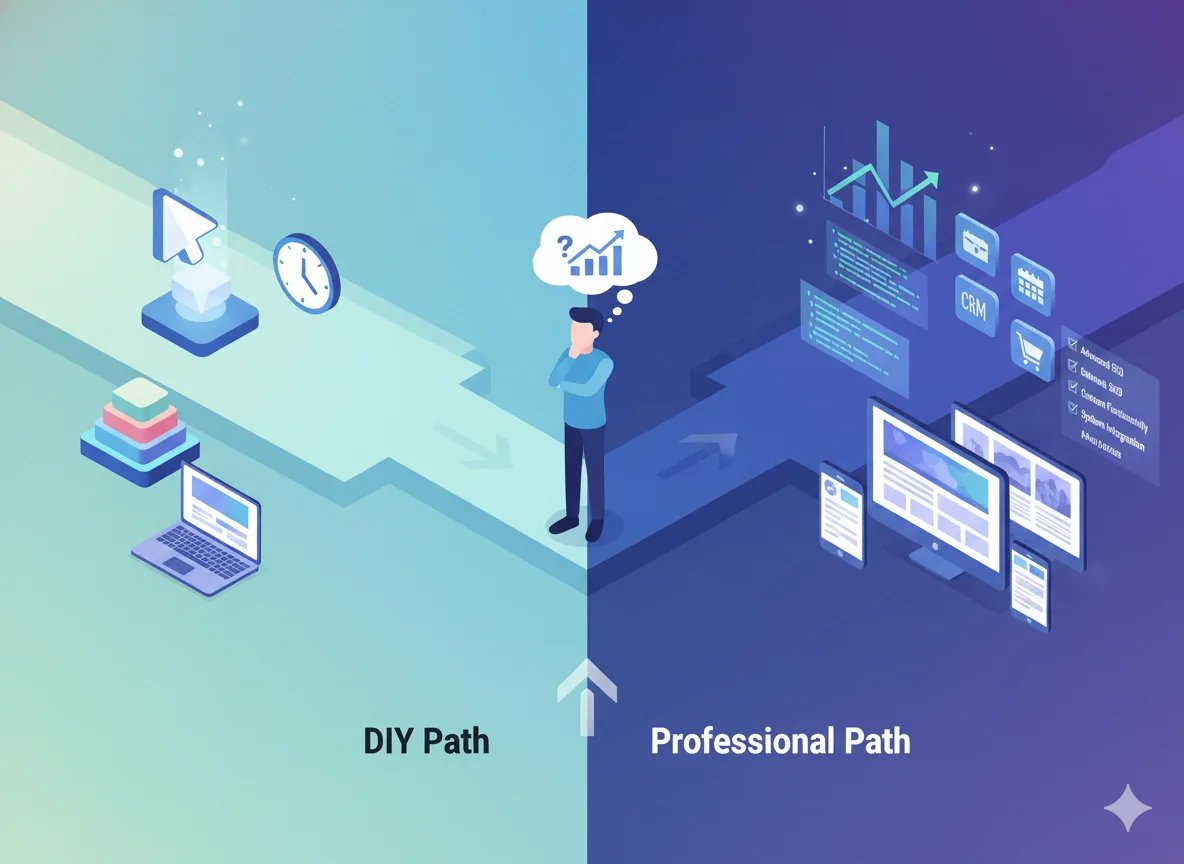
Q: “When should a small business owner consider hiring a professional instead of building their site themselves?”
DIY builders are fantastic for getting started, and there’s nothing wrong with launching on your own when you’re validating an idea or building a simple online presence. Platforms like Wix and Squarespace are intentionally designed for ease of use, helping beginners launch without technical skills.
But there comes a point when a business grows beyond what drag-and-drop tools can comfortably support. This usually happens when goals become more complex things like advanced SEO, performance optimization, custom functionality, or integrated systems such as booking tools, CRM, or e-commerce workflows. Many businesses outgrow template limitations because these platforms weren’t built for deep customization or complex scalability.
Another trigger is when time becomes a barrier. Business owners quickly realize that learning design, UX, content strategy, and technical setup is expensive not in money, but in hours they could devote to revenue-driving work. Research shows that professionally built sites can turn branding and UX into trust and conversion advantages, influencing results and growth potential.
As we often tell clients at Pixwelz:
“The real ROI of a professional website is in conversions, credibility, and scalability.”
DIY helps you get online, but professional support helps you get results. When your website needs to persuade, sell, rank, integrate, or scale, that’s when it’s time to bring in expertise.
Website Builders, SEO, and Performance

Q: “Do website builders affect SEO and website performance?”
Absolutely, the choice of website builder can have a major impact on your site’s SEO, loading speed, and overall performance. And because performance and SEO are closely linked, the platform you choose and how you build your site really matter for long-term success.
Why Builders & Performance Matter
Page load speed and performance are not just technical details; they shape user experience, bounce rate, conversions, and how search engines rank your site. Studies show that even a one-second delay in page load can reduce conversions by around 7%.
Another common finding when a site takes longer than 3 seconds to load, bounce rates rise sharply by roughly 32% compared with sites loading under 3 seconds. In short, slow sites frustrate visitors, increase bounce rate, reduce conversions, and ultimately damage both user trust and SEO performance.

Search engines also treat speed and performance as ranking factors. Fast, well-optimized sites are more likely to rank higher, especially on mobile, where performance and user experience are key ranking signals.
WordPress, Wix, and Shopify Builders Compared: Features, Flexibility & Customization
Off-the-shelf page builders (including some hosted builders or drag-and-drop tools) often make it easy to design a site, but they can introduce performance overhead. Because these builders bundle many features, scripts, and extra styling tools, they may generate heavier code, slower load times, or restrict fine-tuned optimization. A review of page builders found that while some builders don’t severely harm performance on simple pages, complex pages, or heavy use of builder elements can noticeably degrade load times if not optimized.
In contrast, platforms such as WordPress (when properly configured) or Shopify tend to offer more robust control over performance, code optimization, and SEO tools. With WordPress, for example, developers can control caching, optimize assets, manage metadata, and prune unnecessary scripts, all contributing to faster load times and better SEO outcomes. 
That said, a well-optimized site built on a page builder can perform acceptably, especially if the builder is lightweight, the site is simple, and you follow optimization best practices (light themes, optimized images, minimal scripts, caching, CDN, etc).
What Pixwelz Does - Optimize or Migrate When Performance Plateaus
At Pixwelz LTD, we don’t just build websites; we build them for performance and long-term success. If a client’s site uses a template or builder tool but starts to suffer from performance issues (slow loading, large images, heavy code), we audit the site for bottlenecks (unused scripts, heavy assets, poor caching) and optimize wherever possible, compress images, remove unnecessary code, enable caching/CDN, and simplify layouts.
And when optimization isn’t enough, especially if the business is scaling, adding more content, or expecting significant traffic, we often recommend migrating to a more robust platform (like WordPress or Shopify) to ensure SEO, load speed, and user experience remain strong.
The Reality for Business Owners
☑ Fast sites load quickly, which reduces bounce rate and increases conversions.

☑ Slow load times create friction; many users leave before the homepage fully loads, harming engagement and SEO.

☑ SEO and performance go hand-in-hand. Search engines reward fast, stable, well-optimized sites.

Sites that load in one second have conversion rates up to 3× higher than those loading in five seconds, but slow load times can drive away up to 32% more visitors before they even explore your homepage.
Upcoming Website Builder Trends in 2026
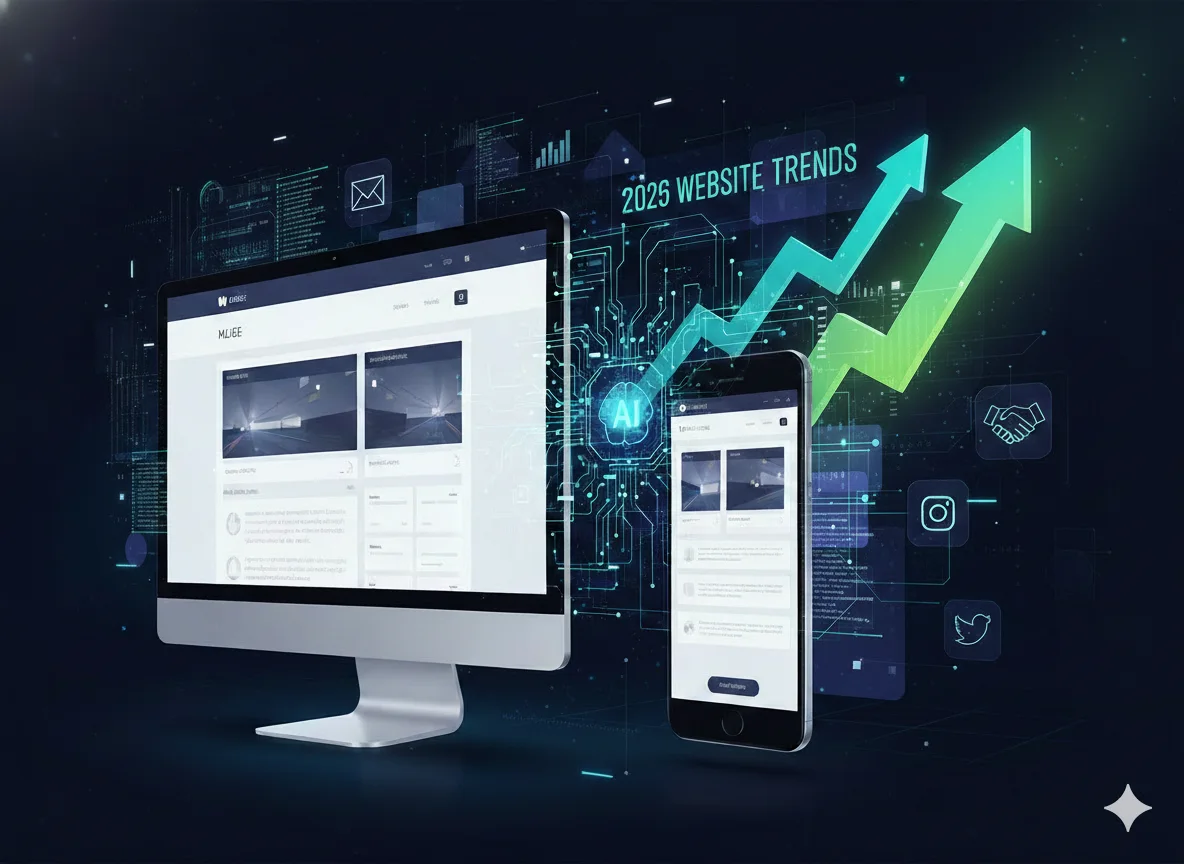
Q: “Are there any upcoming trends in website builders or web design that businesses should know about?”
As we move deeper into 2026, several emerging trends are reshaping how websites are built and what business owners should expect from their web presence.
What’s Changing: Key Trends to Watch
Rise of AI-Assisted Website Design (with caveats)
AI tools are increasingly being used to help design websites: from generating initial layouts, selecting colours, to even helping write copy or suggest images. These tools can speed up the creative process, making it easier, especially for small businesses with limited resources, to get a site up quickly. But there’s a trade-off: while AI can assist with structure, it often lacks the nuanced creativity, brand-specific voice, or advanced UX judgment that a human designer brings. Over-relying on AI templates can lead to sites that feel generic.
More Businesses Migrating from DIY to Scalable / Custom Platforms
As businesses grow, many are realizing that a simple DIY site isn’t enough for long-term ambitions. Around 2026, we’re seeing more companies transition from hosted builders or basic DIY tools to more scalable, flexible platforms (like custom WordPress, e-commerce–ready setups, or fully bespoke builds). They understand that initial simplicity is fine, but growth, performance, and flexibility become increasingly important.
Emphasis on UX-First, Mobile-First and Performance-First Design
With mobile traffic dominating and user expectations rising, websites are increasingly built with UX, loading performance, and mobile responsiveness as top priorities. This trend reflects both user behaviour and search engine standards. Business owners who prioritize these aspects tend to deliver better user engagement, lower bounce rates, and stronger conversions.
Deeper Integration With Marketing Tools, Automation & Analytics
Modern websites are not just online brochures. They’re part of a business’s broader marketing ecosystem. In 2026, more websites are expected to come with built-in or integrated marketing tools: email capture & newsletters, CRM, automation, analytics, SEO tools, e-commerce, and personalization. This shift means that a website builder isn’t just a design tool; it becomes an integral part of marketing, sales, and user retention strategy.
This is the year where strategy and performance will matter more than templates.
At Pixwelz LTD, we’re watching these shifts closely because we believe the next generation of business websites won’t just look good. They’ll perform, adapt, and grow as the business does.
Best Practices for Business Owners
Q: “If you could give business owners three quick tips before choosing a website builder, what would they be?”
First, define your goals clearly. Before choosing a platform, ask: What do I want this website to do? Attract leads, educate clients, showcase my work, or sell products? Industry guidance consistently says that platform decisions should start with business needs, not features or ads.
Second, think ahead and build for where your business is going, not where it is today. Many businesses later discover their first website builder can’t support growth, custom features, or SEO, forcing rebuilds when they scale.
Third, never trade user experience or SEO for convenience. A fast, easy template is great, but if it limits performance, branding, or findability, it can hold your business back. WordPress and Shopify, for example, are often preferred because they allow deeper SEO control and flexibility when you grow.
If business owners focus on these three principles: clarity, scalability, and user-first design, they’ll choose a builder that supports success instead of limiting it.
Q: “If a business owner reading this is unsure where to start, what should they do next?”
The best starting point isn’t picking a platform, it’s talking through your goals. A short conversation can reveal whether you need something simple, something scalable, or something built for selling and automation. At Pixwelz, we don’t push a single solution. We look at where your business is today, where you want it to grow, and then recommend the platform and strategy that makes sense.
Sometimes that means refining a Wix site you already have, other times it means setting up WordPress for long-term growth, or building a Shopify store for serious selling. The key is that your website should support your business, not limit it. We help owners avoid expensive rebuilds, make smarter decisions, and launch sites that feel professional and perform well.
If you’re still unsure which website builder fits your business, the Pixwelz team can help you decide and even build a website that brings measurable results.
.svg)
.svg)
.svg)
.svg)