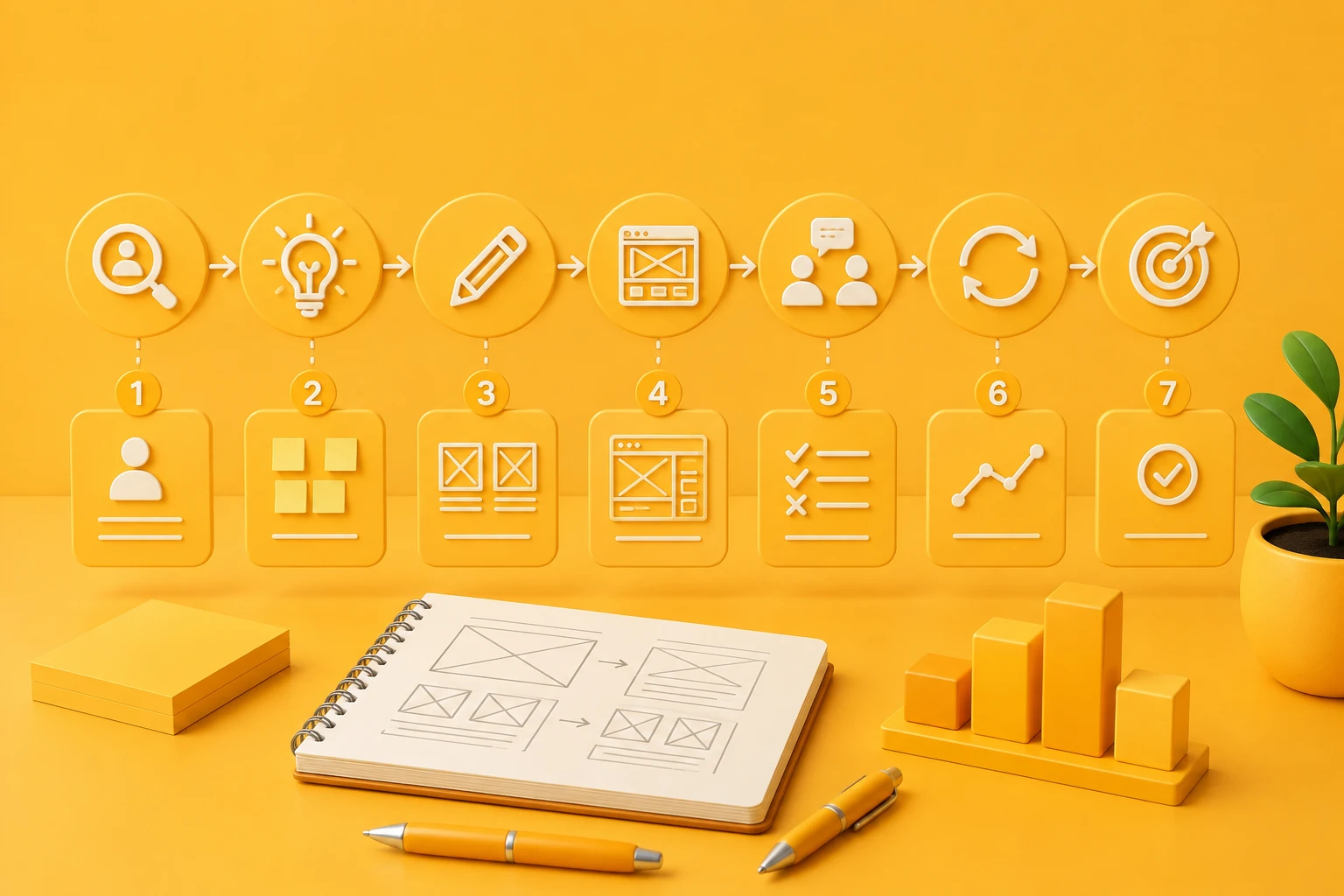
The design process is a clear set of steps. Each step turns a user problem into a tested fix. Designers start with facts, not guesses. They watch how people use a product. Then they note where it breaks.
Research comes first. User researchers talk to people and watch them do tasks. They look for the spots where users get stuck. Notes from these talks shape the whole build.
Ideation opens up the field. Product designers sketch fast and sketch a lot. Crazy eights is one way to do this. Each person draws eight ideas in eight minutes. Weak sketches go on the wall too. They help designers spot the strong ones.
Prototypes make the best idea real. A UI designer tests a layout with a paper sketch in an hour. A Figma file tests a flow in a day. Both cost little to throw out. Cheap drafts guard against a costly build.
User tests put the draft in front of real people. Five users find eight or nine flaws out of ten. This count comes from the Nielsen Norman Group. Small tests cost less. So most researchers test small and test a lot.
Iteration closes the loop. Each round of notes cuts down what designers do not know. The next draft holds fewer guesses than the last. Work stops when the tests come back clean.
The design process matters because it cuts risk. Skip it and you ship a guess. The bill for that guess lands after launch. Run it well and flaws show up while the fix still costs a sketch. A design lead keeps this loop tight. One change per test. Clear notes after each round.
What is a design process?
A design process is a structured framework that guides designers from a user problem to a validated solution. Research reveals user needs first. Empathize and define establish the problem before design work begins.
The design process then moves through ideate, prototype and test. Each stage answers a specific question before the next begins. User feedback shapes every revision and reduces decisions based on assumptions.
Why is a design process important?
A design process is important because it provides a clear roadmap for every project. It reduces risk before development begins. Designers base their decisions on user needs rather than assumptions. The process also creates a consistent method for evaluating ideas throughout each stage.
The importance of a design process is listed below.
Focuses on people: Focuses on people by placing user goals, behaviors and real use cases at the center of every design decision.
Solves problems: Solves problems through clear problem definition before designers develop or evaluate solutions.
Saves time and money: Saves time and money because early validation reduces rework and prevents costly design changes.
Improves teamwork: Improves teamwork with a shared workflow that keeps designers, developers and product managers aligned.
What is the research stage of a design process?
The research stage of a design process is a foundational phase that helps designers gather data about user needs and market context. The stage builds user empathy, supports market analysis and establishes a clear foundation for later decisions. Research also prepares the design process to identify requirements before the next stage begins.
The research stage of a design process is listed below.
Understand users: Understand users through data gathering that reveals user needs, behaviors and expectations.
Analyze context: Analyze context with market analysis that identifies conditions, opportunities and relevant patterns.
Define constraints: Define constraints before ideation starts so designers work within clear project requirements.
What is the ideation stage of a design process?
The ideation stage of a design process is a creative phase that helps designers generate ideas after problem definition. The stage develops potential solutions through free thinking before early judgment limits new concepts. It also connects research insights with design thinking and prepares ideas for the prototyping stage.
The ideation stage of a design process is listed below.
Quantity over quality: Quantity over quality encourages designers to generate many ideas before they evaluate or refine concepts.
Challenge assumptions: Challenge assumptions by questioning early judgments that may limit new directions or alternative solutions.
Explore angles: Explore angles through design thinking that examines different approaches before prototyping begins.
What is the prototyping stage of a design process?
The prototyping stage of a design process is an experimental phase that uses scaled-down versions. It mock-ups solutions and validates concepts before final development. Designers connect ideation with testing during this stage. Gather user feedback to verify ideas early. A low-fidelity prototype or high-fidelity prototype supports evaluation before the testing stage.
The prototyping stage of a design process is listed below.
Test ideas quickly: Test ideas quickly with scaled-down versions that mock up solutions before development begins.
Identify flaws: Identify flaws through user feedback that reveals weak points before formal testing.
Improve solutions: Improve solutions after evaluation and prepare validated concepts for the testing stage.
What is the testing stage of a design process?
The testing stage of a design process is an evaluation phase that uses a prototype with real users to gather feedback and validate ideas. Designers evaluate the user experience before the next revision begins. The stage connects prototyping with iteration through evidence instead of assumptions.
The testing stage of a design process is listed below.
Check user reactions: Check user reactions through feedback from real users that confirms whether design decisions meet user expectations.
Find mistakes: Find mistakes by evaluating the prototype and identifying issues that affect the user experience.
Learn and fix: Learn and fix with evidence from user feedback before the iteration stage begins.
What is the iteration stage of a design process?
The iteration stage of a design process is a repeating cycle that uses real user feedback to improve the design after a prototype completes testing. Designers compare testing results with user feedback before they make changes. Each revision supports refinement and prepares the next version with stronger evidence and clearer direction.
The iteration stage of a design process is listed below.
Prototyping: Prototyping provides the prototype that designers review before each design revision.
Testing: Testing supplies evidence that identifies issues and guides the next design update.
Analyzing: Analyzing examines real user feedback to identify patterns that support informed design decisions.
Refining: Refining improves the design through measured changes before the next testing cycle begins.
How does a design process support better design decisions?
A design process supports better design decisions because it turns evidence into informed decisions throughout structured phases. Designers evaluate user insights before they select a solution. This approach helps reduce risk and strengthens team alignment with clear decision criteria instead of guesswork.
The ways a design process supports better design decisions are listed below.
User focus: User focus places user insights at the center of every design decision and keeps solutions aligned with real needs.
Early testing: Early testing uses evidence to reduce risk before designers approve final design decisions.
Fact-based options: Fact-based options use structured phases to compare alternatives and maintain team alignment throughout the design process.
What makes a design process effective?
An effective design process is user-centered, iterative and collaborative because it keeps design decisions aligned with human needs. Designers evaluate feedback throughout the project. Continuous testing supports informed revisions. Cross-functional teamwork keeps design, development and product decisions aligned from start to finish.
The elements of an effective design process are listed below.
User focus: User focus keeps design decisions centered on human needs and user expectations.
Flexibility: Flexibility supports iterative improvements through continuous testing and regular feedback.
Prototyping: Prototyping validates design ideas before final development and reduces unnecessary revisions.
Teamwork: Teamwork strengthens cross-functional collaboration between designers, developers and product managers.
What are the best practices for a design process?
The best practices for a design process include user research, clear goals, market research, prototyping, early testing and continuous iteration. These practices keep design decisions aligned with user needs and project objectives. Designers rely on each practice to reduce uncertainty and improve decision quality throughout the design process.
The best practices for a design process are listed below.
Know your user: Know your user through user research that reveals real needs, expectations and behaviors.
Set clear goals: Set clear goals that establish project direction and support consistent design decisions.
Check the market: Check the market with market research that compares design ideas with current conditions.
Build prototypes: Build prototypes through prototyping that turns concepts into designs ready for evaluation.
Test early: Test early to identify issues before final development and reduce unnecessary revisions.
Iterate continuously: Iterate continuously with continuous iteration that improves the design after each evaluation.
What to consider when you use a design process?
A design process requires careful consideration because it keeps work aligned with user needs and project constraints. Continuous feedback supports informed design decisions throughout the project. Collaboration, flexibility and validation keep each decision consistent before the process moves forward.
The considerations for using a design process are listed below.
Human-centered focus: Human-centered focus keeps every design decision aligned with user needs.
Problem definition: Problem definition establishes project constraints before design work begins.
Collaboration: Collaboration keeps designers, developers and product managers aligned throughout the project.
Constraints: Constraints define practical limits that guide design decisions.
Flexibility: Flexibility allows design decisions to adapt as continuous feedback reveals new information.
Validation: Validation confirms design direction before the next project stage begins.
Does every project use the same design process?
Not every project uses the same design process because project needs, timelines and real-world constraints determine how each project moves forward. A website design project may require shorter review cycles, while other projects require greater flexibility. Even so, the core objectives remain consistent and support clarity, usability and effective results.
When to adapt a design process?
A design process adapts when changing project needs, user feedback, project scope, technical constraints and stakeholder changes affect project direction. During mobile app design, flexibility keeps design decisions aligned with project goals while the process responds to changing conditions.
What challenges affect a design process?
Several challenges affect a design process, like unclear scope, tight time limits, poor user research, scope creep and communication gaps. These issues disrupt planning, reduce decision quality and weaken project consistency throughout the design process.
How do designers keep a design process consistent?
Designers keep a design process consistent through shared standards across every project. A design system, reusable component libraries, standardized frameworks and style guides establish consistent practices and strengthen team alignment.
What makes a design process successful?
A design process becomes successful when decisions rely on evidence instead of assumptions. User research builds user empathy. Collaboration, continuous testing, iterative testing and cross-functional alignment maintain consistent decisions and improve design quality.
.svg)
.svg)
.svg)
.svg)